
- 2331
- 0
Sharing Ideas and Updates on LPG in Nigeria and related information to enable effective collaboration within the LPG Value Chain


Dangote At Global Insights Conference: Redefining Africa’s Refined Fuel Market And LPG Landscape
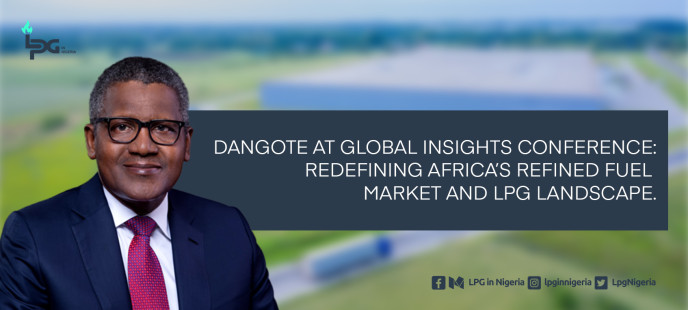
Dangote At Global Insights Conference: Redefining Africa’s Refined Fuel Market And LPG Landscape

At the recent Global Commodity Insights Conference on the West African Refined Fuel Market, the President of Dangote Group, Alhaji Aliko Dangote, delivered a powerful address that captured the transformation underway in Africa’s downstream oil and gas sector. His remarks not only highlighted the growing capacity of African refineries but also addressed regulatory hurdles, unfair trade practices, and the strategic role of Liquefied Petroleum Gas (LPG) in reshaping the continent’s energy security.
This blog post explores Dangote’s key messages and their broader implications, particularly for LPG production, consumption, and policy development in Nigeria and West Africa.
A Changing Fuel Landscape: From Import Dependency to Local Production
Africa currently produces 7 million barrels of crude oil daily, yet only 4 million barrels are consumed on the continent. Of this, Nigeria and Egypt account for about 40%, underlining the dominant role these two nations play in shaping regional demand.
However, with over 120 million metric tons of refined petroleum products consumed per year representing a $90 billion market opportunity, the continent still largely relies on imports to meet domestic energy needs. Paradoxically, only 15% of African countries have GDPs above $90 billion, which makes sustained importation of refined products economically irrational.
Dangote's position is clear: Africa must break the cycle of exporting crude and importing finished products. “It defies logic,” he argued, calling instead for collaboration, fair trade, and regional self-sufficiency.
LPG: A Key Part of the Dangote Refinery’s Strategy
Of particular relevance to Nigeria’s domestic energy transition is the revelation that Dangote Refinery is now producing 2,500 metric tons of LPG daily, supplying roughly 70% of Nigeria’s current market demand. This is a significant shift in a sector long dependent on imports and volatile international pricing.
This level of production places Nigeria in a strong position to:
Stabilize local LPG prices
Enhance supply consistency
Expand access to cleaner cooking fuels, especially in rural areas
With such production levels, LPG is fast becoming a strategic product, not just for household use but as a marker of local capacity, industrial strength, and energy security.
Regulatory Roadblocks and the Need for Harmonised Standards
Despite these gains, regulatory misalignment across West Africa is threatening market integration. Dangote highlighted that his refinery’s fuels currently cannot be sold in some West African countries due to a lack of harmonised product standards.
For example:
Diesel cloud point requirements in Nigeria are 4°C, while other West African countries use 7°C or more.
These standards were originally tailored for colder climates, not tropical regions like Nigeria, creating artificial trade barriers.
This inconsistency doesn’t just affect petrol or diesel, it also threatens to stifle regional LPG trade. If LPG specifications are not standardised, cross-border sales will remain difficult and local producers may be undercut by foreign imports with looser regulations.
The Dumping Problem: A Threat to Quality and Local Investment
Another major concern raised by Dangote is the dumping of substandard or toxic petroleum products, including discounted Russian crude, into African markets. These products, while cheap, often fail environmental and health safety benchmarks and undermine local producers who follow global standards.
This trend extends to LPG, where low-cost but poorly regulated imports can depress prices in ways that discourage domestic investment and expansion. This creates a vicious cycle of dependency, quality compromise, and reduced local innovation.
Dangote called on African governments and regulatory bodies like the NMDPRA to follow the example of the U.S. and Europe by protecting their domestic refining industries through:
1.Stronger regulations
2.Border protection against illegal dumping
3.Transparent trade practices
LPG, Polypropylene, and a Vision for Industrial Growth
Dangote also revealed that his refinery will begin producing Polypropylene, a critical input in plastics manufacturing, with Nigeria only able to consume 30% of its projected output at full capacity. The implication is clear: Nigeria could become a net exporter of multiple petroleum by-products, LPG included.
With plans to list the refinery on the Nigerian Stock Exchange, there is also a push for greater transparency, accountability, and public participation in the country’s refining revolution.
Importantly, Dangote emphasized that he is not pursuing monopoly. Instead, he has bet on Nigeria when others hesitated. He called for more players to build refineries, more competition, and government support for new entrants, with the NMDPRA playing a facilitative not restrictive role.
Conclusion: Time for Action, Not Caution
The Dangote Refinery is more than a private venture it is a symbol of what African industrial ambition can achieve when matched with regulatory reform, infrastructure investment, and regional cooperation. LPG is a core part of this story. As the refinery ramps up production, Nigeria now has a unique opportunity to:
Displace biomass with cleaner cooking fuels
Strengthen energy independence
Export surplus LPG to neighbouring countries
But this can only happen with harmonised standards, anti-dumping enforcement, and incentives for local investors.
At LPG in Nigeria, we are closely tracking these developments and advocating for policies that support the long-term growth of the LPG sector. Follow us on WhatsApp, Facebook, and X (Twitter) for data, insights, and market intelligence that help operators and consumers make smarter energy choices.
Let’s shape the future of LPG for Nigeria, for West Africa, and for the continent.
Share on Social Media:
Are you setting up, or do you need LPG information? Get started with our LPG and CNG Webinars!
Do you need LPG Depot Prices and Mont Belvieu Prices Data Sheet (2019 till date)? Get Access here!
You May Also Like

0 Comment.