


- 720
- 2
Sharing Ideas and Updates on LPG in Nigeria and related information to enable effective collaboration within the LPG Value Chain


Carbon Credits: Where They Came From, What They Mean, And Why Nigeria Should Care
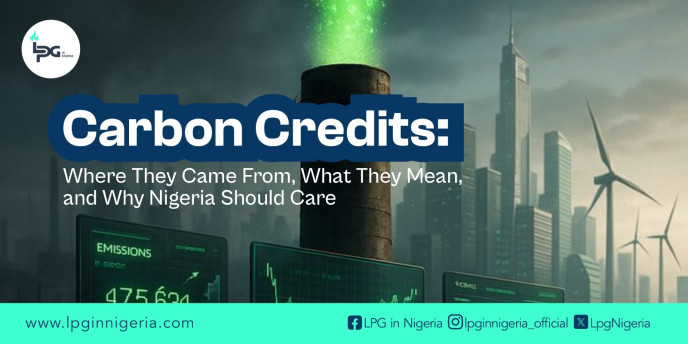
Carbon Credits: Where They Came From, What They Mean, And Why Nigeria Should Care

How do you reduce global emissions in a way that is economically realistic?
That question is what gave birth to carbon credits.
And to understand carbon credits properly, we need to understand both their history and their language.
The Etymology: What Does “Carbon Credit” Actually Mean?
Let’s break the term down.
Carbon refers to carbon dioxide (CO₂), the most common greenhouse gas produced by human activity especially from burning fossil fuels like oil, gas, and coal.
Credit comes from the Latin credere, meaning “to believe” or “to trust.” In financial systems, a credit represents value earned or allocated that can be exchanged.
So a carbon credit literally means:
A trusted unit of value representing a verified reduction of carbon emissions.
One carbon credit equals one metric tonne of carbon dioxide (or its equivalent in other greenhouse gases) that has been reduced, avoided, or removed from the atmosphere.
It’s climate change translated into accounting language.
What Started Carbon Credits?
Carbon credits were born out of international climate diplomacy.
The key turning point was the Kyoto Protocol, adopted in 1997 under the United Nations Framework Convention on Climate Change (UNFCCC).
The Kyoto Protocol introduced a groundbreaking idea:
Instead of forcing every country to reduce emissions domestically at the same pace, allow countries to trade emission reductions.
In other words:
If Country A reduces more emissions than required, it can sell the surplus reduction to Country B.
This created the first formal carbon market.
Kyoto established three mechanisms:
Emissions Trading
Joint Implementation
Clean Development Mechanism (CDM)
The Clean Development Mechanism is particularly important for countries like Nigeria. It allowed developed countries to invest in emission-reduction projects in developing countries and receive carbon credits in return.
That’s where the modern carbon credit system truly began.
Why Governments Chose a Market Solution
Reducing emissions globally is expensive.
Some countries can reduce emissions cheaply (for example, by replacing outdated coal plants). Others face much higher costs.
Economists argued that if emissions reductions could be traded, the global cost of fighting climate change would drop.
It’s the same logic behind financial markets:
Allocate resources where they are most efficient.
Instead of every country reducing one tonne of carbon at whatever cost, reductions could happen where they were cheapest and be traded.
This was climate policy meeting economic theory.
How Carbon Credits Work Today
There are now two main carbon markets:
1. Compliance Markets
These are government-mandated systems. Companies are legally required to limit emissions.
Examples include:
The EU Emissions Trading System
Regional systems in parts of North America
Companies that exceed their allowed emissions must buy credits.
Participation is compulsory.
2. Voluntary Carbon Markets
This is where much of the recent growth has happened.
In voluntary markets, companies choose to buy carbon credits to offset emissions as part of ESG commitments or net-zero goals.
This is not mandated by law.
It is driven by:
Investor pressure
Consumer expectations
Sustainability reporting
Corporate branding
This is the market where developing economies including Nigeria can play a stronger role.
How a Carbon Credit Is Created
A carbon credit is not simply declared. It must be earned.
A project must prove:
Additionality – The emissions reduction would not have happened without carbon finance.
Measurability – The reduction can be quantified accurately.
Verification – Independent auditors confirm the results.
Permanence – The reduction is durable over time.
Projects can include:
Solar mini-grids replacing diesel generators
Gas flare reduction systems
Reforestation projects
Clean cooking initiatives
Methane capture from waste
Once verified, credits are issued and can be sold in global markets.
Why Carbon Credits Expanded After Kyoto
After Kyoto, the idea evolved.
The 2015 Paris Agreement expanded global climate cooperation. It encouraged countries to set their own climate targets (Nationally Determined Contributions or NDCs).
Article 6 of the Paris Agreement provides the legal framework for international carbon markets going forward.
This means carbon trading is no longer just a Kyoto-era experiment. It is becoming part of mainstream global climate architecture.
The Criticism: Is It Just Greenwashing?
Let’s be honest.
Carbon credits have faced significant scrutiny.
Some critics argue:
Companies use offsets instead of cutting emissions internally.
Some projects exaggerate emission reductions.
Poor verification standards undermine credibility.
Local communities do not always benefit fairly.
And in some cases, those criticisms are valid.
The credibility of carbon credits depends entirely on integrity. Weak governance damages trust.
For countries like Nigeria, entering the carbon market requires strong regulatory oversight.
Carbon finance without integrity becomes greenwashing.
Carbon finance with integrity becomes development finance.
Carbon Credits and Nigeria: A Strategic Lens
Nigeria holds the largest proven gas reserves in Africa.
It also faces:
High levels of gas flaring
Significant deforestation
Energy access challenges
Rapid urbanization
Each of these represents both a problem and an opportunity.
Gas Flaring Reduction
Capturing associated gas instead of flaring it reduces emissions.
Such projects can generate carbon credits while also supporting domestic gas supply.
That aligns with national energy expansion goals.
Clean Cooking Transition
Millions of Nigerian households still rely on biomass (firewood and charcoal).
Switching to LPG reduces:
Deforestation
Indoor air pollution
Carbon emissions
Carbon credits can help subsidize LPG adoption.
This is where climate finance intersects with energy access.
Renewable Mini-Grids
Replacing diesel generators in rural areas with solar systems creates measurable carbon reductions.
Each system can generate credits.
This turns clean energy infrastructure into a revenue-generating asset.
The Link Between Carbon Credits and LPG
This connection deserves more attention.
When households switch from charcoal to LPG:
Carbon emissions drop.
Forest degradation slows.
Health improves.
Women and children spend less time gathering firewood.
If structured properly, carbon finance can lower the cost of LPG cylinders and infrastructure.
That means carbon credits can directly accelerate clean cooking penetration in Nigeria.
Climate finance becomes an economic tool for domestic energy expansion.
The Bigger Question
Carbon credits were not created as a moral gesture.
They were created as a market solution to a global problem.
Their effectiveness depends on three things:
Integrity
Transparency
Strategic alignment
Carbon credits can infact be earned in realtime and Naira in Nigeria! LPG in Nigeria is collaborating with a vCRM platform to bring that to you and we will be discussing this in our next blog post.
Share on Social Media:
Are you setting up, or do you need LPG information? Get started with our LPG and CNG Webinars!
Do you need LPG Depot Prices and Mont Belvieu Prices Data Sheet (2019 till date)? Get Access here!
2 Comments.

You May Also Like




Umar Usman Yauri
22 February 2026 - 07:18amYour write ups are always educating and beneficial to anyone who took time to read. May Allah increases your knowledge. Thanks
Reply