


- 3010
- 0
Sharing Ideas and Updates on LPG in Nigeria and related information to enable effective collaboration within the LPG Value Chain


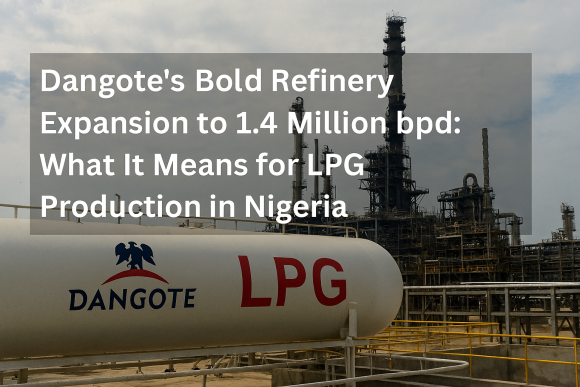
Dangote’s Bold Refinery Expansion To 1.4 Million Bpd: What It Means For LPG Production In Nigeria
Dangote’s Bold Refinery Expansion To 1.4 Million Bpd: What It Means For LPG Production In Nigeria

The Dangote Petroleum Refinery has once again captured global headlines with its plan to expand capacity from 650,000 barrels per day (bpd) to an astonishing 1.4 million bpd, making it the largest refining complex in the world. This strategic move, confirmed by Aliko Dangote in an interview with S&P Global, is more than an industrial milestone; it signals a potential transformation in Nigeria’s Liquefied Petroleum Gas (LPG) landscape, energy security, and market stability.
Dangote’s expansion plan, backed by Middle Eastern investors and a recently secured $4 billion financing deal is not just about refining more crude oil. It’s about rebalancing Africa’s energy equation. Since beginning operations, the refinery has already positioned Nigeria as a net exporter of diesel and aviation fuel, significantly reducing the country’s import bills and foreign exchange pressures. With this expansion, Nigeria could also see a surge in LPG (cooking gas) output, a byproduct of crude refining and a crucial energy source for millions of homes and businesses. The refinery’s design already accommodates LPG recovery systems, and scaling capacity will increase output, potentially easing the chronic supply shortages and price volatility that have plagued the Nigerian LPG market in recent months.
What This Means for Nigeria’s LPG Market
From a market perspective, the expansion could be a game-changer. Here’s why:
1. Higher Domestic LPG Production
At 1.4 million bpd, the refinery will process far more crude and, consequently, produce more LPG as a natural derivative of refining. This could reduce dependence on imports from the Nigeria Liquefied Natural Gas (NLNG) plant and international suppliers, a dependence that currently exposes the market to freight costs, currency fluctuations, and global price swings.
2. Price Stability and Reduced Scarcity
Nigeria’s LPG market has recently faced severe fluctuations from refinery shutdowns to supply disruptions and rising retail prices. The expanded Dangote capacity could introduce a steady and predictable supply stream, helping to curb speculative pricing and stabilise retail costs nationwide.
3. Stronger Downstream Infrastructure
With more LPG supply expected, there will be greater demand for storage, bottling, and distribution infrastructure. This could spur new investments in skid plants, storage tanks, bobtails, and retail outlets, particularly in inland regions underserved by current logistics networks.
4. Boost for Clean Cooking and Energy Transition
More affordable and available LPG aligns directly with Nigeria’s clean energy goals and its National Gas Expansion Programme (NGEP). Increased production can support the government’s push to transition millions of households from firewood and charcoal to cleaner cooking gas, improving public health and reducing deforestation.
5. Market Competition and Private Sector Growth
Dangote’s pricing model has already disrupted the LPG market, offering lower ex-depot prices compared to other depots. A capacity expansion means the refinery could further strengthen its pricing influence, encouraging healthy competition and possibly prompting other players to upgrade facilities or offer better rates to stay relevant.
While the expansion presents optimism, structural challenges remain. Distribution infrastructure, regulatory bottlenecks, and safety compliance continue to limit the efficiency of Nigeria’s LPG value chain. Without coordinated policies on logistics, cylinder recirculation, and pricing transparency, even increased supply could struggle to reach end users efficiently.
Also, the relationship between Dangote Refinery and offtakers (marketers who lift LPG from the refinery) will determine how quickly price benefits reach consumers. If marketers maintain wide margins or face high transport costs, retail prices could remain elevated despite lower refinery gate prices.
The Dangote expansion isn’t just a story about scale, it’s about strategic transformation. For the first time, Nigeria could become self-sufficient not only in refined fuels but also in LPG, reshaping the entire energy ecosystem.
The refinery’s upcoming projects including linear alkylbenzene, base oil, and polypropylene production indicate a long-term vision to anchor Nigeria’s petrochemical and LPG markets around domestic value creation. As the refinery targets a partial listing on the Nigerian Stock Exchange and explores equity partnerships, it’s also signaling transparency and long-term institutional stability, two factors the Nigerian energy market sorely needs.
At LPG in Nigeria, we view this development as a potential inflection point for the entire gas value chain. With refinery capacity doubling, there is a real opportunity to build a coordinated, transparent LPG market, one that connects producers, offtakers, distributors, and consumers more efficiently. However, policy coherence and logistics investment are key. The government, regulators, and industry stakeholders must work together to ensure that this surge in LPG output does not bottleneck at the depots or lead to uneven distribution. If well managed, the Dangote expansion could move Nigeria from chronic scarcity to sustainable abundance, supporting clean energy access, rural development, and economic diversification.
Summary
Dangote’s refinery expansion is not just about refining more oil; it’s about refining Nigeria’s energy future. By potentially doubling LPG production, improving price stability, and strengthening domestic supply chains, this project could mark the beginning of a more stable, sustainable, and self-reliant LPG industry in Nigeria and across Africa.
SOURCE: S&P GLOBAL
Share on Social Media:
Are you setting up, or do you need LPG information? Get started with our LPG and CNG Webinars!
Do you need LPG Depot Prices and Mont Belvieu Prices Data Sheet (2019 till date)? Get Access here!
You May Also Like


0 Comment.