

- 17
- 0
Sharing Ideas and Updates on LPG in Nigeria and related information to enable effective collaboration within the LPG Value Chain


Tinubu Orders Nationwide Deployment Of 100,000 CNG Conversion Kits
Tinubu Orders Nationwide Deployment Of 100,000 CNG Conversion Kits

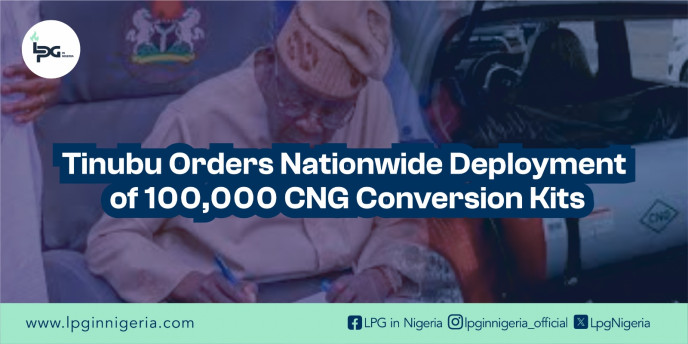
Nigeria’s push toward gas-powered transportation has received fresh momentum. Bola Tinubu has directed the Presidential Compressed Natural Gas Initiative (PiCNG) to deploy 100,000 vehicle conversion kits nationwide, a move aimed at reducing the pressure of rising petrol prices while expanding access to cheaper fuel alternatives. The directive was revealed by Ismael Ahmed after a meeting with the President at the Presidential Villa in Abuja. According to Ahmed, the President requested a detailed briefing on the progress of the CNG programme and the steps being taken to cushion the impact of rising global petroleum prices.
The decision comes at a time when Nigeria’s fuel market is experiencing significant volatility. Recent increases in petrol prices, partly influenced by global geopolitical tensions, including conflicts involving Iran, the United States, and Israel, have intensified pressure on domestic fuel costs and government policy responses.
Scaling Up Nigeria’s Gas Transition
The President’s directive essentially mandates PiCNG to accelerate the nationwide rollout of conversion kits that will enable vehicles to run on Compressed Natural Gas (CNG) instead of petrol. According to Ahmed, the President’s primary concern was expanding the availability and accessibility of gas as a transportation fuel across the country.
“The President wanted to know what we are doing to scale up gas availability nationwide,” Ahmed explained. “He has given a direct mandate that we should immediately deploy about 100,000 conversion kits.”
These kits will allow motorists to modify existing petrol-powered engines to run on CNG. The programme is expected to cover a broad range of vehicle categories, including private cars, commercial transport vehicles, and even tricycles used in urban mobility.
Conversion centres across the country are currently being prepared for the large-scale rollout. Once operational, these centres are expected to become active hubs where vehicle owners can convert their engines to run on natural gas. For many Nigerians, especially commercial transport operators, the conversion programme could represent a major cost-saving opportunity in the long term.
Expanding the Gas Infrastructure
Beyond vehicle conversions, the initiative is also investing heavily in the infrastructure required to support gas-powered mobility. Ahmed disclosed that about 77 refuelling stations are currently at various stages of development nationwide. These stations will provide the critical supply network needed for vehicles running on CNG. Some progress has already been recorded. The northern commercial hub of Kano already hosts two Liquefied Compressed Natural Gas (LCNG) stations, while additional daughter stations are currently being developed to expand supply access.
The infrastructure rollout will follow major transport corridors across the country. According to Ahmed, key routes such as Lokoja, Abuja, Kaduna, Zaria will serve as strategic supply channels extending further north to Kano and Maiduguri. This corridor-based development strategy is designed to ensure that long-distance transportation networks can reliably access gas refuelling stations.
A Broader Energy Transition Strategy
Nigeria’s gas mobility push did not begin recently. The Presidential CNG Initiative was launched in 2023 following the removal of petrol subsidies. At the time, the programme was positioned as both a short-term relief mechanism for Nigerians grappling with higher fuel prices and a long-term energy transition strategy designed to deepen domestic gas utilisation.
Nigeria holds some of the largest proven natural gas reserves in Africa, yet much of the country’s transportation sector has historically depended on petrol and diesel.
By promoting gas-powered mobility, policymakers hope to achieve multiple objectives simultaneously:
Reduce petrol demand
Lower transportation fuel costs
Expand domestic gas utilisation
Cut emissions from the transport sector
The current directive to deploy 100,000 conversion kits reflects the government’s attempt to accelerate this transition.
Petrol Price Pressures Driving Policy
Recent developments in the fuel market have further reinforced the urgency of the programme. Nigeria has witnessed several petrol price adjustments in recent weeks as global market conditions fluctuate. In particular, the Dangote Refinery recently increased its gantry price for Premium Motor Spirit (PMS) to ₦1,175 per litre, marking the third upward adjustment within a short period.
However, the refinery later reduced its ex-depot price to ₦1,075 per litre, highlighting the volatility currently affecting Nigeria’s petrol pricing structure.
For policymakers, this volatility strengthens the argument for diversifying the country’s transportation fuel sources.
Implementation Challenges
Despite strong policy backing, the CNG initiative has not been without challenges.
Reports indicate that although the programme has attracted more than $2 billion in private sector investment, implementation has progressed slower than initially expected.
Key bottlenecks include:
Limited refuelling infrastructure
High initial vehicle conversion costs
Limited public awareness of CNG technology
Logistics constraints in nationwide rollout
These factors have slowed adoption rates, even as government agencies continue to promote the programme. The directive to deploy 100,000 conversion kits could therefore be seen as an attempt to inject new momentum into the initiative.
Our perspective at LPG in Nigeria is that if successfully implemented, the expansion of CNG conversions could reshape Nigeria’s transportation energy mix over the next decade. Gas-powered mobility has the potential to reduce pressure on petrol demand, lower transport operating costs, and strengthen the domestic gas market.
For commercial transport operators, many of whom spend a large share of their income on petrol switching to gas could significantly reduce daily operating expenses.
At a broader level, the programme also aligns with Nigeria’s long-standing policy ambition to become a “gas-powered economy.”
However, the success of the initiative will ultimately depend on how quickly infrastructure expands and how effectively vehicle conversion programmes are implemented nationwide. For now, the President’s directive signals a clear message: Nigeria’s transition toward gas-powered transportation is moving from policy discussions into accelerated implementation.
SOURCE: Nairametrics
Share on Social Media:
Are you setting up, or do you need LPG information? Get started with our LPG and CNG Webinars!
Do you need LPG Depot Prices and Mont Belvieu Prices Data Sheet (2019 till date)? Get Access here!
You May Also Like

0 Comment.