

- 938
- 0
Sharing Ideas and Updates on LPG in Nigeria and related information to enable effective collaboration within the LPG Value Chain


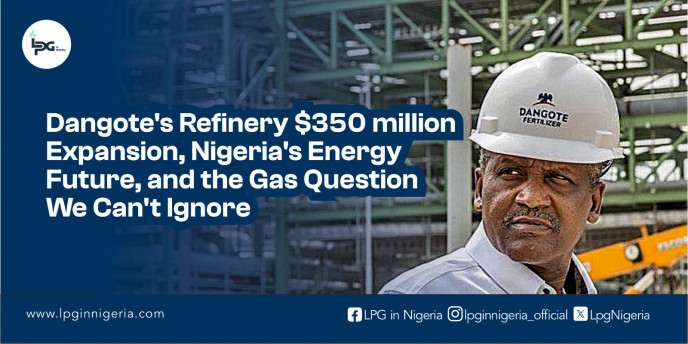
Dangote’s Refinery $350 MillionExpansion, Nigeria’s Energy Future, And The Gas Question We Can’t Ignore
Dangote’s Refinery $350 MillionExpansion, Nigeria’s Energy Future, And The Gas Question We Can’t Ignore

When news broke that Dangote Group had signed a $350 million deal with India’s Engineers India Ltd (EIL) to expand the Lagos refinery, my first reaction was simple: this is massive. Not just in figures, but in what it represents for Nigeria’s long-standing struggle with fuel dependence, industrial capacity, and economic self-confidence. But as with most big projects in Nigeria, the excitement deserves a deeper conversation, one that looks at both the promise and the pressure points of this expansion.
So let’s talk about it.
What Exactly Is Dangote Expanding?
The plan is ambitious. Very ambitious.
The Dangote Refinery, located in the Lekki Free Zone, is already the world’s largest single-train refinery with a capacity of 650,000 barrels per day (bpd). Under the new agreement with EIL, Dangote plans to add a second processing train, pushing total capacity to 1.4 million bpd. If completed as planned, this would place the Dangote complex among the largest single-location refinery and petrochemical facilities in the world.
And it’s not just about fuel.
The expansion also significantly boosts petrochemical production, especially polypropylene, which is used in everything from plastic packaging to automotive components. Production is set to rise from 830,000 tonnes per annum to 2.4 million tonnes per annum, supported by new polypropylene units and a world-scale UOP Oleflex unit. In short, Dangote isn’t just refining crude oil, it’s building a full industrial ecosystem.
While the headlines focused, understandably, on petrol, diesel, and Nigeria’s long dependence on imported fuel. But the more I sat with the announcement, the clearer it became that this expansion is about far more than PMS and AGO. It is about the direction of Nigeria’s entire energy system and, crucially, what it means for LPG, CNG, and AutoGas. On the surface, this is a story of scale and ambition. Beneath it, however, lies a deeper conversation about energy security, industrial structure, and whether Nigeria is finally ready to move from raw resource extraction to value-driven energy utilisation.
For decades, Nigeria has lived with a contradiction that defies logic. We produce crude oil in large quantities, yet import most of the fuels we consume. This dependence has shaped fuel scarcity, subsidy politics, foreign exchange pressure, and economic instability. The Dangote Refinery began to change that narrative in 2024 when it started producing diesel, aviation fuel, and later petrol. This expansion signals an intention to make that shift permanent. But the refinery is not just about liquid fuels. Increased refining capacity means more processing, more outputs, and more by-products. This is where the conversation around gas becomes unavoidable.
LPG, in particular, stands to be affected in meaningful ways. LPG is not produced in isolation; it emerges from both crude oil refining and natural gas processing. With a refinery operating at this expanded scale, Nigeria’s prospects for improving domestic LPG availability become stronger. Today, despite being a gas-rich country, Nigeria still relies heavily on LPG imports. A larger, more integrated refining and petrochemical complex strengthens the case for local supply, reduced import dependence, and a more predictable market environment. For households, this could translate into improved availability over time. For investors and operators, it signals long-term confidence in the LPG value chain.
The implications extend beyond cooking gas. CNG has often been framed narrowly as a transport solution, but its viability rests on deeper industrial foundations. Large-scale gas processing, consistent supply, and infrastructure development are what make transport gas markets sustainable. The Dangote expansion contributes to this foundation by strengthening Nigeria’s gas processing ecosystem and reinforcing demand certainty. Without that industrial backbone, CNG remains an idea rather than a system. AutoGas, which sits at the intersection of LPG and transport, also enters the picture. For years, AutoGas has struggled in Nigeria not because it lacks economic or environmental benefits, but because it lacks structure. Supply constraints, weak regulation, and poor safety enforcement have limited adoption. Stronger domestic LPG availability changes part of that equation. It does not solve everything, but it removes one of the biggest barriers. Availability creates opportunity. Regulation determines whether that opportunity becomes progress or risk.
This is where the excitement around the expansion must be tempered with realism. Large projects bring advantages, but they also introduce vulnerabilities. One of the most obvious risks is concentration. When so much refining and petrochemical capacity sits in one location, any disruption has wide-reaching consequences across multiple fuel streams, including LPG. There is also the persistent issue of crude supply. A refinery of this size requires consistent, competitively priced feedstock, something Nigeria’s upstream sector has struggled to guarantee due to theft, underinvestment, and regulatory uncertainty. Policy remains another pressure point. Infrastructure is advancing faster than regulation. While refining capacity is expanding, gas-specific frameworks for LPG distribution, CNG deployment, and AutoGas conversion are still catching up. Without clear standards, certified conversion practices, and consistent enforcement, public confidence will continue to lag behind physical capacity.
Still, it is difficult to ignore the upside. Scale creates confidence. Confidence attracts investment. Investment supports infrastructure, and infrastructure enables markets to function more efficiently. The petrochemical expansion, in particular, offers Nigeria a chance to deepen industrial linkages by supplying inputs to local manufacturing rather than exporting raw materials and importing finished goods. In many ways, Dangote’s refinery sits at the centre of Nigeria’s energy transition. It has already begun easing fuel shortages and reducing import dependence. With this expansion, it also becomes a key anchor for the gas conversation, whether policymakers acknowledge it or not.
This is why the refinery expansion should not be viewed simply as a petrol story. It is a gas story as well. For LPG, it represents the possibility of stronger domestic supply and market stability. For CNG, it supports the industrial scale needed for meaningful transport adoption. For AutoGas, it creates an opening that can only succeed if safety, standards, and public education are taken seriously. The infrastructure is rising quickly. The ambition is undeniable. The real test now is whether Nigeria’s policies, institutions, and safety culture can rise at the same pace. If they can, this expansion may mark a turning point not just for fuels, but for how Nigeria finally builds a coherent, resilient, and value-driven energy economy.
Source: Business Insider Africa.
Share on Social Media:
Are you setting up, or do you need LPG information? Get started with our LPG and CNG Webinars!
Do you need LPG Depot Prices and Mont Belvieu Prices Data Sheet (2019 till date)? Get Access here!
You May Also Like

0 Comment.