


- 2226
- 0
Sharing Ideas and Updates on LPG in Nigeria and related information to enable effective collaboration within the LPG Value Chain


Seplat’s 12,600-MT LPG Push: Import Substitution, Price Relief Or Just A First Step?
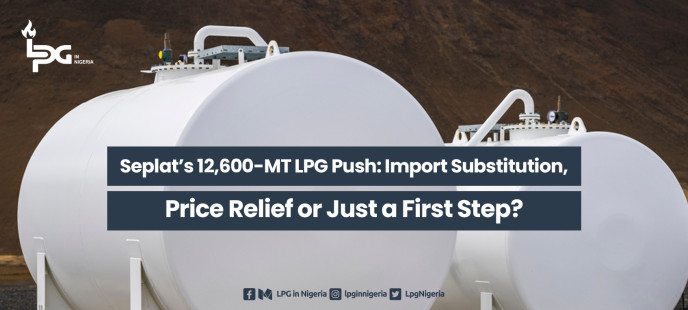
Seplat’s 12,600-MT LPG Push: Import Substitution, Price Relief Or Just A First Step?

Seplat Energy PLC and its JV partner NNPC Ltd have completed a landmark 12,600 metric-ton (MT) domestic cargo of LPG (butane) from the Bonny River Terminal (BRT), a terminal whose LPG output has historically gone offshore. For Nigeria’s clean-cooking agenda, this is a meaningful pivot: more local molecules staying local.
Below, we unpack why this matters, what it could do to prices and availability, and crucially, what must happen next to turn a promising headline into durable change. We also share LPG in Nigeria’s perspective from the front lines of retail pricing, consumer behaviour, and operator feedback.
Why this shipment matters
Import substitution at scale: Nigeria’s annual LPG demand has exceeded 1 million MT in recent years. A single 12,600-MT domestic delivery is roughly ~1% of annual demand not a silver bullet, but a real dent in import dependence.
Household impact (in plain numbers): 12,600 MT equals ~1,008,000 fills of a 12.5-kg cylinder. That’s the kind of volume everyday Nigerians feel when supply chains work.
Signal, not just supply: BRT’s pivot from export-only to meaningful domestic allocation is as important as the tonnage. It tells the market that more local product can be retained when infrastructure and commercial terms align.
The pipeline behind the headline
Seplat’s broader gas build-out gives this story legs:
ANOH Gas Plant (Imo, 300 MMscfd) and Sapele Gas Plant (Delta, 90 MMscfd) both include LPG units capable of ~120 MT/day and ~163 MT/day, respectively.
At nameplate, that’s ~283 MT/day, or ~103,000 MT per year, enough LPG for ~22,600 12.5-kg cylinders every single day once fully ramped.
Seplat expects both plants to be fully operational in Q4 2025 (company guidance). If execution matches guidance, domestic LPG availability materially improves in 2026.
Will prices fall?
Short answer: They can, but only if logistics, financing, and market rules support the molecules.
What helps prices:
Shorter supply chains: Coastal-to-domestic deliveries reduce forex exposure and freight.
Steadier cadence of cargoes: Smoother flows relax “panic premiums” in inland depots and retail.
Competition on the coast: More Nigerian producers offering domestic volumes can chip away at import-parity pricing.
What still keeps prices high:
Weak inland logistics: Bad roads, insufficient storage, and costly bridging to the North and far East.
FX volatility & kit imports: Many components (pumps, valves, skids, cylinders) are import-priced.
Retail bottlenecks: Cylinder scarcity, fragmented distribution, and safety compliance costs.
Our take (LPG in Nigeria): Expect moderate relief first on the coast and large metros, with slower transmission inland unless mini-depots, rail/truck logistics, and agent networks are scaled in tandem.
What this means for clean cooking
Nigeria still has tens of millions of households cooking with wood, charcoal, or kerosene. More local LPG means:
Fewer stock-outs → more trust in LPG as a primary fuel.
Lower landed costs (over time) → faster cylinder adoption and refill frequency.
Better health outcomes → reduced indoor air pollution, especially for women and children.
But availability must be paired with cylinders and safety. Without cylinders in the right sizes (3–6–12.5 kg) and affordable swaps, supply gains won’t translate to kitchens.
Risks & realities to watch
Export pull vs. domestic need: If export netbacks outpay the local market, domestic allocation can shrink. Solutions: domestic offtake MOUs, predictable FX windows, and transparent pricing formulas.
Infrastructure gaps: More coastal LPG means little if mini-depots, refilling clusters, and last-mile agents aren’t scaled across zones.
Regulatory follow-through: NMDPRA must enforce safety, licensing, and cylinder standards to avoid a race to the bottom.
Financing friction: Retailers and transporters need working capital, soft loans for storage/cylinders, and credit guarantees to pass supply gains into retail price relief.
What success looks like (12–18 months)
Regular domestic cargo cadence from BRT and other terminals.
ANOH & Sapele LPG units hitting stable output and selling more locally than abroad.
100k+ new compliant cylinders/month entering the market via OEMs and importers.
Mini-depots commissioned in underserved geographies (North West, North East, rural South East).
Data-backed price moderation: coastal retail stabilizing first, with inland spread narrowing 10–20% versus today’s gaps.
Safety outcomes improving (fewer incidents, better compliance at retail and transport).
LPG in Nigeria: our view & commitments
We welcome Seplat’s domestic cargo as real progress and an early proof that Nigeria can keep more LPG at home. If ANOH and Sapele deliver as planned, 2026 could be the first year Nigerians feel structural (not seasonal) improvements in availability.
At LPG in Nigeria, we will:
Track retail prices and availability weekly across states (crowd-sourced on X, Facebook, and WhatsApp).
Publish monthly dashboards linking domestic cargoes to retail trends.
Map infrastructure gaps (storage, mini-depots, cylinder supply) and spotlight bankable projects.
Amplify safety, training, standards, and incident prevention.
Follow us for ground-truth data and practical guidance because the clean-cooking transition is won (or lost) at the neighborhood cylinder point, not just at the terminal.
Bottom line
Seplat’s 12,600-MT domestic LPG shipment is a genuine milestone and a strong signal that Nigerian producers can power Nigerian kitchens. Turning that signal into sustained price relief and universal access now depends on logistics, cylinders, finance, and firm regulation. If industry and government move in sync, this isn’t just less imports, it’s the start of a more resilient, affordable LPG era for Nigerian households and businesses.
Share on Social Media:
Are you setting up, or do you need LPG information? Get started with our LPG and CNG Webinars!
Do you need LPG Depot Prices and Mont Belvieu Prices Data Sheet (2019 till date)? Get Access here!
You May Also Like





0 Comment.