

- 2253
- 0
Sharing Ideas and Updates on LPG in Nigeria and related information to enable effective collaboration within the LPG Value Chain


The $10 Billion Push For Africa’s LPG Future And What It Means For Nigeria’s Energy Reality
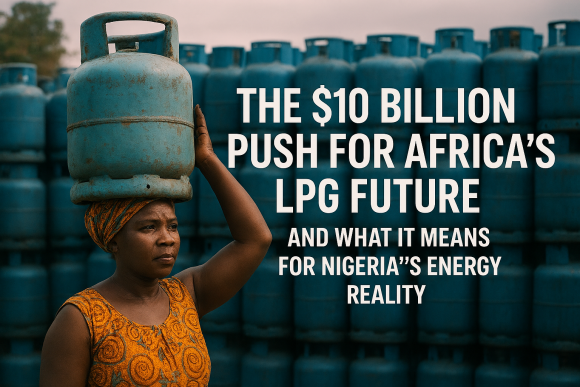
The $10 Billion Push For Africa’s LPG Future And What It Means For Nigeria’s Energy Reality

In September 2025, a consortium of U.S.-based energy companies unveiled an ambitious $10 billion plan to expand Liquefied Petroleum Gas (LPG) use across ten African countries. The initiative, launched in New York with support from U.S. Energy Secretary Chris Wright, aims to invest in LPG import terminals, storage facilities, and cylinders signaling a major global push to accelerate clean cooking adoption across Africa.
While this announcement has generated optimism across the continent, it raises important questions for Nigeria, Africa’s largest LPG market about what kind of future we are truly building for our domestic energy sector.
Africa’s Clean Cooking Challenge
Across Africa, nearly one billion people still depend on firewood, charcoal, or animal waste for cooking, according to the International Energy Agency (IEA). This not only drives deforestation with an estimated 1.3 million hectares of forest lost annually but also leads to severe health risks. Household air pollution from unsafe cooking methods contributes to 815,000 premature deaths every year, primarily from respiratory and cardiovascular diseases.
LPG has emerged as a practical, scalable solution to this crisis. The IEA reports that three-quarters of Africa’s clean cooking access in the past five years has been achieved through LPG adoption. It burns cleaner, reduces harmful particulates (PM2.5), and saves millions of women and children from toxic indoor air exposure.
However, scaling LPG use across Africa and sustaining it depends on investment, policy alignment, and affordability. This is where the conversation about Nigeria’s current LPG realities becomes crucial.
The Nigerian Context: Promise Meets Paradox
Nigeria, with its vast gas reserves, should be a model for affordable and accessible LPG use. Instead, it is a market battling scarcity, fluctuating prices, and unstable supply chains. Despite major efforts by both the public and private sectors, including the establishment of the Dangote Refinery and continued supply from Nigeria LNG (NLNG), the country has struggled to maintain consistent LPG availability.
In recent months, industrial disputes, such as the PENGASSAN strike and temporary disruptions from the Dangote Refinery, have caused sharp price surges and supply gaps. Average prices across Nigerian states rose to nearly ₦18,000 for a 12.5kg cylinder in September 2025, reflecting an artificial inflation driven by logistical breakdowns and dependence on a few major suppliers.
While African nations like Côte d’Ivoire are using subsidies and consistent policies to drive nationwide LPG adoption, Nigeria’s market remains volatile caught between deregulation goals and the absence of coordinated supply management.
Learning from Africa’s Emerging Models
The LPG success story in Côte d’Ivoire where access has jumped from 50% to 85% in just five years provides lessons for Nigeria. The Ivorian government’s decision to subsidize LPG prices and maintain stability, alongside adopting the cylinder recirculation model, has proven transformative.
This model, already being introduced in Ghana and Kenya, ensures that marketers, not consumers, own and maintain gas cylinders improving safety, reducing costs, and promoting efficiency. It’s a system that Nigeria has long discussed but struggled to implement due to policy bottlenecks, enforcement challenges, and fragmented infrastructure.
At the same time, stable policy environments as seen in India and Brazil have enabled rapid LPG growth through targeted subsidies, strong regulation, and private-sector confidence. Nigeria’s frequent policy reversals and inconsistent regulatory signals, however, have discouraged investors from committing to long-term LPG infrastructure projects.
LPG in Nigeria’s Perspective: The Urgent Need for Structural Reforms
At LPG in Nigeria, we believe the U.S. led $10 billion investment plan is a positive development for Africa but it should also serve as a wake-up call for Nigeria to put its house in order.
Nigeria does not need external solutions as much as it needs internal coordination, policy consistency, and infrastructural investment. The current dependence on a few producers and refineries makes the market fragile, and without transparent communication on supply volumes and distribution timelines, price volatility will persist.
Moreover, Nigeria must strengthen its midstream and downstream LPG infrastructure from bottling plants to storage and distribution ensuring that urban and rural consumers alike have reliable access. Regulatory agencies like the NMDPRA and Standards Organisation of Nigeria (SON) must enforce safety and quality standards while encouraging innovation and digital monitoring systems across the supply chain.
Finally, Nigeria needs to confront the affordability gap. While subsidies can be politically sensitive, targeted mechanisms for low-income households — similar to Côte d’Ivoire’s model can ensure that the shift to cleaner fuels is not just for the urban middle class but for everyone.
Conclusion: Nigeria at a Crossroads
As global attention turns toward Africa’s LPG future, Nigeria finds itself at a pivotal moment. The country has the resources, the expertise, and the industrial capacity to lead Africa’s clean cooking revolution yet policy fragmentation and inconsistent supply continue to hold it back.
The U.S. consortium’s $10 billion plan underscores how attractive the African LPG market has become. For Nigeria, the choice is clear: remain reactive to external investment trends, or take bold steps to strengthen local capacity, stabilize prices, and democratize access to clean energy.
If the lessons from Côte d’Ivoire, Kenya, and India are anything to go by, the path forward for Nigeria’s LPG market lies in clear policy, transparent supply chains, and deliberate investment in domestic infrastructure.
At LPG in Nigeria, we believe that the future of clean cooking in Nigeria will not be built by foreign capital alone it will be secured by strategic collaboration, sound governance, and a unified national vision for affordable, sustainable, and inclusive energy access.
Source: Ben Payton for African Business
Share on Social Media:
Are you setting up, or do you need LPG information? Get started with our LPG and CNG Webinars!
Do you need LPG Depot Prices and Mont Belvieu Prices Data Sheet (2019 till date)? Get Access here!
You May Also Like

0 Comment.