

- 1955
- 0
Sharing Ideas and Updates on LPG in Nigeria and related information to enable effective collaboration within the LPG Value Chain


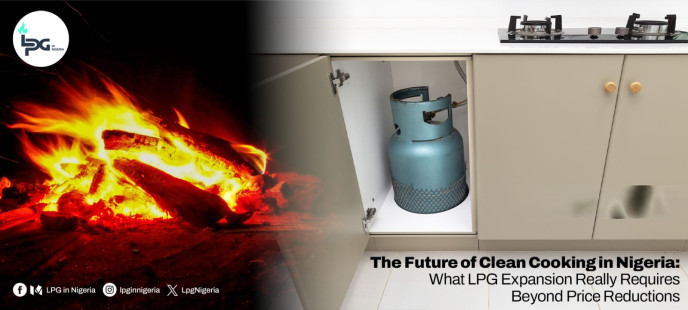
The Future Of Clean Cooking In Nigeria: What LPG Expansion Really Requires Beyond Price Reductions
The Future Of Clean Cooking In Nigeria: What LPG Expansion Really Requires Beyond Price Reductions

For years, stakeholders in Nigeria’s energy sector have repeated a familiar message: reducing the price of Liquefied Petroleum Gas (LPG) will accelerate nationwide adoption. While affordability is undeniably important, recent events have demonstrated that lower LPG prices alone cannot solve Nigeria’s clean cooking challenge. With more than 70% of Nigerian households still relying on firewood, charcoal, kerosene, and other unsafe fuels (IEA, 2022), the true path to clean cooking requires a deeper examination of issues far beyond market-driven price cuts.
Countries such as Côte d’Ivoire, Kenya, and India show that price is only one piece of a much larger puzzle. For Nigeria to make genuine progress toward SDG 7 (clean and affordable energy for all) and its own Clean Cooking Policy ambitions, LPG expansion must be built on lasting reforms in infrastructure, distribution, safety, financing, and consumer trust.
1. Can Cheaper LPG Alone Drive Adoption? The Evidence Says No
While recent price cuts from the Dangote Refinery have briefly lowered ex-depot prices, retail prices remain inconsistent due to logistics, off-taker pricing, marine handling costs, and market speculation. Even if sustained price reductions occur, affordability does not automatically translate to accessibility.
Evidence from global and African markets shows that:
Households adopt LPG only when supply is reliable and refills are consistently available.
Upfront costs (cylinders, regulators, burners) remain prohibitive for millions of Nigerians.
Safety perceptions significantly affect consumer trust, especially after frequent gas explosion incidents.
Cultural and cooking habits such as large-pot meals make small single-burner LPG stoves insufficient.
Thus, price reduction is a welcome development, but it cannot drive mass adoption without structural reforms.
2. The Real Barriers: Infrastructure, Distribution, Safety, and Affordability
a. Infrastructure and Storage Deficits
Nigeria consumes about 1.2 million MT of LPG annually, but infrastructure has not grown proportionately. Storage terminals, inland depots, and transport networks are insufficient.
This results in:
Frequent supply bottlenecks
High transport costs to northern states
Retail shortages during refinery or import disruptions
By contrast, Kenya and Côte d’Ivoire have invested steadily in storage, port terminals, and distribution hubs, enabling more stable supply.
b. Distribution and Cylinder Circulation Challenges
One of Nigeria’s biggest obstacles is the individual-ownership cylinder model, where consumers must buy, maintain, and refill their cylinder. This system creates:
High upfront cost barriers
Unsafe refilling practices
Fragmented market competition
Reluctance from marketers to invest in quality cylinders
Countries that made major progress, India through the Pradhan Mantri Ujjwala Yojana (PMUY) and Côte d’Ivoire through state-supported recirculation and subsidies relied on marketer-owned cylinder circulation. This model:
Reduces upfront costs to household
Ensures safer, well-maintained cylinders
Enables exchange at any outlet
Increases refill frequency
Without nationwide adoption of a functional Cylinder Recirculation Model (CRM), Nigeria may continue to struggle with unsafe practices and low adoption.
c. Safety Concerns and Consumer Trust
In Lagos, Ogun, and across the country, gas explosion incidents have increased due to:
Illegal roadside refilling
Leaking cylinders
Poorly regulated skids
Old, damaged hoses and accessories
Fear of explosions makes many households, especially in rural regions, unwilling to switch to LPG despite its benefits. A robust safety framework with enforcement, trained retailers, and standardized equipment is urgently necessary.
d. Affordability Must Address More Than Price per KG
Beyond the cost of the gas itself, households face:
₦30,000–₦85,000 for cylinders
₦10,000 upwards for burners and regulators
Transport costs to refill points
Price fluctuations due to supply disruptions
In Côte d’Ivoire, the government capped the refill price of a 6 kg cylinder at CFA 2,000 ($3.55) for years, an effective subsidy of nearly 50% (World Bank, 2022). This stability allowed household adoption to soar from around 50% to 85% in five years.
Nigeria, however, lacks such affordability protection.
3. Lessons from Côte d’Ivoire, Kenya, and India
Côte d’Ivoire: The Power of Subsidies and Stability
LPG access rose from 50% to 85% between 2018 and 2023.
Success driven by subsidies and marketer-owned cylinders.
Consistent policy direction encouraged private investment.
Kenya: Market Competition and Pay-As-You-Cook Innovation
Pay-as-you-cook LPG helped low-income households adopt gas safely.
Autogas expansion demonstrates consumer confidence in LPG.
Challenges remain with illegal refilling and fragmented pricing.
India: Scale, State Capacity, and Financing
LPG access increased from 55% to over 95% within five years under PMUY.
Government offered free cylinders, financing, and refill subsidies.
Digital tracking ensured safety and transparency.
These countries show that clean cooking transitions require deliberate, long-term investment not just short-term price cuts.
4. What Nigeria Must Do: Policy, Infrastructure, Safety, and Equity
a. Implement the Cylinder Recirculation Model (CRM) Nationwide
CRM shifts ownership from consumers to marketers, improving safety and reducing upfront cost. Nigeria has drafted CRM policies, but implementation has been slow.
b. Introduce Targeted LPG Subsidies
Subsidies should focus on:
Low-income households
First-time cylinder acquisition
Refill price stabilization
Rural communities
c. Strengthen Safety Enforcement and Standardization
Mandatory certification of retailers
Ban illegal roadside refilling
National safety audit of cylinders and tanks
Public education campaigns
d. Expand Storage and Inland Distribution
More depots in the North
Better transport infrastructure
Government-supported investment incentives
e. Support Local Production and Reduce Import Dependence
Ensure transparent scheduling and communication from Dangote Refinery
Strengthen NLNG domestic allocation
Develop smaller modular LPG extraction facilities
f. Encourage Pay-As-You-Cook and Micro-Financing Models
These models help low-income households overcome affordability barriers sustainably.
Conclusion: Nigeria’s Clean Cooking Future Depends on More Than Price
While Dangote’s price reductions are a positive development, they are not enough. Nigeria cannot rely on price drops alone to deliver clean cooking access to over 200 million people; the future hinges on policy consistency, safety reform, infrastructure investment, and innovative distribution models. Suppose Nigeria adopts the kinds of reforms that succeeded in Côte d’Ivoire, Kenya, and India. In that case, it can finally move beyond episodic market disruptions and begin a true, sustained clean cooking transformation.
Sources:
International Energy Agency (IEA). (2022). Africa Energy Outlook.
Argus Media: Kenya makes strides in LPG expansion but hurdles remain
World Bank: Unlocking Clean Cooking Pathways
Kenya: Kenya National Cooking Transition Strategy (Executive Summary): PDF
India: Pradhan Mantri Ujjwala Yojana (PMUY) Programme
India: Evidence & analysis of PMUY’s impact
Share on Social Media:
Are you setting up, or do you need LPG information? Get started with our LPG and CNG Webinars!
Do you need LPG Depot Prices and Mont Belvieu Prices Data Sheet (2019 till date)? Get Access here!
You May Also Like


0 Comment.