


- 1250
- 0
Sharing Ideas and Updates on LPG in Nigeria and related information to enable effective collaboration within the LPG Value Chain


Unlocking Nigeria’s Gas Potential: Why Power, Domestic Utilisation, And Deepwater Development Matter And What It Means For LPG
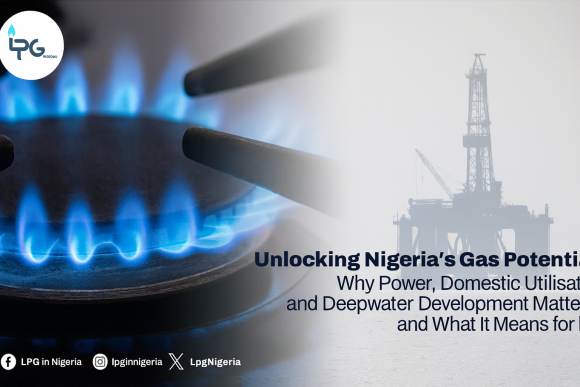
Unlocking Nigeria’s Gas Potential: Why Power, Domestic Utilisation, And Deepwater Development Matter And What It Means For LPG

Nigeria’s long-standing ambition to build a gas-driven economy has been at the centre of its national energy agenda for over a decade. With abundant reserves exceeding 206 trillion cubic feet, the country holds one of the largest gas endowments in the world. Yet, despite its vast resources, Nigeria still struggles to achieve stable power supply, robust domestic gas utilisation, and the infrastructural development needed to unlock deepwater resources. These gaps have hindered the nation’s progress toward industrial growth, energy security, and economic diversification.
This essay examines three critical issues limiting Nigeria’s gas transition, gas-to-power shortcomings, weak domestic utilisation, and underdeveloped deepwater gas assets and explores their implications for the rapidly evolving LPG (Liquefied Petroleum Gas) sector.
1. Gas-to-Power: The Foundation Nigeria Has Not Yet Built
Electricity remains the single most important driver of industrialisation, job creation, and economic growth. Nigeria’s inability to translate its immense gas reserves into reliable power generation has been a major hindrance to national development.
Although the country has over 13,000 MW of installed generation capacity, fewer than 5,000 MW consistently reach the grid. The reasons are well known: persistent gas shortages, vandalised pipelines, and the recurring issue of unpaid debts to gas producers. These factors not only undermine investor confidence but also stall major power projects that depend solely on steady gas supply.
The failure of gas-to-power integration also affects the LPG industry indirectly. When power grids fail and industries cannot rely on electricity, they increasingly turn to alternative energy sources, including diesel and biomass both more polluting and costlier than gas-based fuels. This limits the expansion of LPG into industrial heating, manufacturing, and small-scale power applications, sectors where LPG could otherwise thrive.
A more reliable gas-to-power system would therefore create a ripple effect: reduced energy costs, greater investor confidence, and increased demand for LPG as an industrial and commercial fuel.
2. Weak Domestic Utilisation: A Gas-Rich Country That Consumes Too Little
While Nigeria is a major exporter of LNG, its local utilisation of gas remains surprisingly low. In many advanced economies, natural gas powers buses, factories, households, and industries. In Nigeria, adoption has been slow due to inconsistent policy implementation, inadequate pipeline infrastructure, limited financing, and fluctuating pricing frameworks.
Government initiatives promoting compressed natural gas (CNG) and broader gas-based industrialisation have not reached desired levels of impact. Ordinary Nigerians still rely heavily on petrol and diesel because gas-powered mobility systems, refuelling stations, and distribution networks remain insufficient.
This same issue affects the LPG sector in profound ways. Although LPG consumption has grown significantly in the last decade, rising from about 70,000 MT in 2007 to over 1.3 million MT in recent years, Nigeria still lags behind its peers. Many households remain dependent on firewood and charcoal, not because LPG is unavailable, but because distribution remains uneven, affordability fluctuates, and safety awareness is low.
Poor domestic gas utilisation also limits the growth of gas-based industries that could otherwise stimulate demand for LPG cylinders, accessories, filling plants, and smart monitoring technologies. For example:
Nigeria’s low level of industrialisation reduces the uptake of LPG as an industrial heating and fuel source.
Weak enforcement of clean cooking policies slows down household LPG adoption.
High international prices, exacerbated by reliance on imports, create seasonal scarcity pressures.
A truly successful domestic gas market would boost LPG adoption across homes, small businesses, transport fleets, and industries.
3. Deepwater Gas Reserves: The Missing Pillar of Long-Term Supply Security
Nigeria’s offshore basins contain massive untapped deepwater gas reserves that could shape the next phase of national growth. However, development has stalled due to regulatory uncertainty, high project costs, and delayed investment decisions by international oil companies.
Major projects such as Bonga Southwest and Preowei have faced prolonged postponements, weakening Nigeria’s competitiveness in the global gas arena. Meanwhile, emerging African gas producers like Mozambique, Tanzania, and Mauritania are gaining investor attention. For the LPG industry, deepwater gas development is more than an upstream concern; it is a long-term supply issue. Domestic LPG production remains insufficient because Nigeria still imports a large portion of the LPG consumed locally. Deepwater gas development would:
Expand feedstock availability for domestic LPG production
Reduce import dependency and stabilize market prices
Reduce foreign exchange pressures on LPG marketers
Enhance affordability for consumers
Position Nigeria as a potential LPG export hub
Without developing these reserves, Nigeria will continue to experience supply constraints that directly impact household LPG prices and availability.
Conclusion: A Gas Future That Depends on Strategic Reform
Nigeria’s journey toward a gas-led future stands at a crossroads. Gas-to-power integration is weak, domestic utilisation remains underdeveloped, and deepwater resources remain untapped. These gaps not only undermine national energy security but also restrict the growth of industries like LPG, which depend on stable gas infrastructure, clear policies, and affordable supply.
Unlocking Nigeria’s gas potential requires decisive policy action, investment in critical infrastructure, and a shift from export dependency to domestic value creation. If Nigeria gets these three pillars right, the LPG sector, along with power generation, transportation, and manufacturing, can drive a new era of economic progress and clean energy adoption. The next decade could define Nigeria’s place in the global energy landscape. But without urgent reforms, the nation risks watching other emerging gas economies take the lead.
Source: Business Day.
Share on Social Media:
Are you setting up, or do you need LPG information? Get started with our LPG and CNG Webinars!
Do you need LPG Depot Prices and Mont Belvieu Prices Data Sheet (2019 till date)? Get Access here!
You May Also Like


0 Comment.