

- 755
- 1
Sharing Ideas and Updates on LPG in Nigeria and related information to enable effective collaboration within the LPG Value Chain


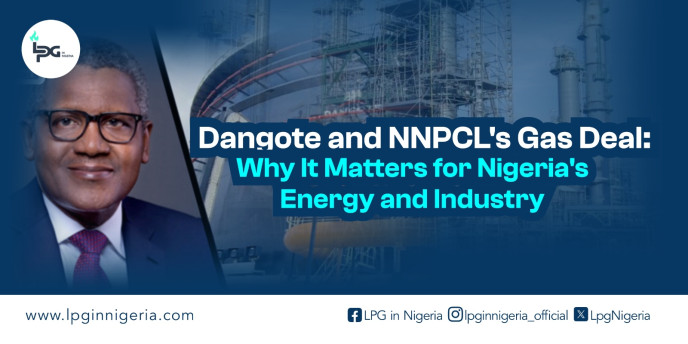
Dangote And NNPCL’s Gas Deal: Why It Matters For Nigeria’s Energy And Industry
Dangote And NNPCL’s Gas Deal: Why It Matters For Nigeria’s Energy And Industry

Big moves are happening in Nigeria’s gas space, and this one is worth paying attention to. Dangote Industries Limited (DIL) and the Nigerian National Petroleum Company Limited (NNPCL) have just sealed an enhanced gas supply agreement designed to support Dangote Group’s expanding industrial operations. On the surface, it sounds like another corporate partnership. But dig a little deeper, and it tells a much bigger story about where Nigeria’s energy and industrial sectors are headed.
What’s actually been signed?
At the heart of the deal is a scaled-up Gas Sales and Purchase Agreement (GSPA) between key Dangote subsidiaries — Dangote Petroleum Refinery, Dangote Fertiliser Plant, and Dangote Cement Plc, and NNPCL’s gas-focused subsidiaries, Nigerian Gas Marketing Limited and NNPC Gas Infrastructure Company Limited. In simple terms: Dangote is locking in more gas, over a longer horizon, to power its rapidly growing operations. And NNPCL is committing to reliably supply that gas. The agreements were signed during the unveiling of the NNPC Gas Master Plan 2026 (NGMP 2026) in Abuja, an important signal that this partnership aligns with Nigeria’s broader gas strategy, not just private-sector ambitions.
Why gas, and why now?
Gas is fast becoming the backbone of Nigeria’s industrial future. It’s cleaner than fuel oil and coal, more efficient for large-scale production, and abundant locally. For a group like Dangote, whose businesses span refining, cement, and fertiliser, energy reliability isn’t a “nice to have”; it’s existential. Speaking at the signing, Dangote Refinery’s Managing Director, David Bird, described the agreement as a critical milestone in the refinery’s expansion drive. The logic is clear: you can’t scale production without securing the energy to run it. This deal helps remove that uncertainty. For Dangote Cement, the agreement directly supports its strategic objectives, including increased production capacity and a stronger push toward cleaner fuels like compressed natural gas (CNG). Fertiliser production, meanwhile, is fundamentally gas-based; natural gas isn’t just an energy source; it’s a core input.
The bigger policy picture
What makes this deal especially significant is how neatly it fits into Nigeria’s evolving gas policy framework. The Minister of State for Petroleum Resources (Gas), Rt. Hon. Ekperikpe Ekpo described the Gas Master Plan as a shift from “policy articulation to disciplined execution.” That phrase matters. Nigeria has never lacked plans or potential; what’s been missing is consistent follow-through. Nigeria holds over 210 trillion cubic feet of proven gas reserves, with upside potential far beyond that. Yet industries still struggle with supply reliability, infrastructure gaps, and pricing issues. The NGMP 2026 aims to change that by focusing on execution, commercial viability, and coordination across the entire gas value chain. NNPCL’s leadership echoed this tone. The company’s GCEO, Bashir Ojulari, positioned the Gas Master Plan as an execution-anchored roadmap, with ambitious but measurable targets: ramping up national gas production to 10 billion cubic feet per day by 2027 and 12 billion by 2030, while unlocking tens of billions of dollars in new investments.
Why this deal is more than just Dangote
While Dangote Group is the immediate beneficiary, the ripple effects extend far beyond one conglomerate.
First, large, bankable gas offtake agreements help justify investment in gas infrastructure like pipelines, processing facilities, and distribution networks. When suppliers know there’s guaranteed demand, projects move faster.
Second, industrial gas demand helps stabilise the domestic gas market. Instead of flaring gas or exporting all the value, more molecules are converted into cement, fertiliser, refined products, and jobs within Nigeria.
Third, it reinforces gas as a transition fuel, supporting economic growth while gradually lowering the carbon intensity of energy use, especially compared to diesel and heavy fuel oil.
Our perspective: what this means for LPG in Nigeria
From an LPG standpoint, this development is quietly encouraging.
Stronger gas infrastructure and a reliable domestic supply are foundational to a healthier LPG market. When gas production, processing, and transportation improve, LPG benefits indirectly, through better feedstock availability, improved logistics, and more confidence for investors across the gas value chain. Nigeria’s LPG sector still faces familiar challenges: affordability, distribution bottlenecks, and inconsistent supply in some regions. But deals like this signal a maturing gas ecosystem, one where gas is treated as a strategic national asset, not just a by-product of oil.
If the Gas Master Plan delivers on its promises and partnerships like this are executed effectively, LPG adoption, especially for cooking and small-scale industrial use, stands to gain. More gas in the system, better infrastructure, and clearer policy direction ultimately support the shared goal we care about most: making clean, reliable energy accessible to more Nigerians.
Share on Social Media:
Are you setting up, or do you need LPG information? Get started with our LPG and CNG Webinars!
Do you need LPG Depot Prices and Mont Belvieu Prices Data Sheet (2019 till date)? Get Access here!
1 Comment.

You May Also Like

Opene augustine oputa ofili
11 February 2026 - 03:10pmCng repair kit r9 cryo star nh3 solutions lpg
Reply